The Software-as-a-Service (SaaS) market has matured into a highly competitive battleground. For founders, product managers, and software architects, selecting the foundational technology stack is no longer just a technical decision—it is a critical business strategy. The chosen framework directly impacts time-to-market, operational costs, security posture, and the ability to scale seamlessly as user demand grows.
While several development ecosystems vie for attention, ASP.NET Core has quietly and decisively emerged as an industry-leading framework for building modern, cloud-native SaaS platforms. Far removed from its legacy, Windows-only predecessors, modern ASP.NET Core is an open-source, cross-platform, high-performance powerhouse designed from the ground up for modern cloud architectures.
This article explores why ASP.NET Core is uniquely positioned to handle the rigorous demands of SaaS development and the tangible advantages it offers your business, development team, and bottom line.
1. Unmatched Performance and Cloud Cost Optimization
In a SaaS model, operational profitability is tightly bound to infrastructure expenses. A framework that consumes excessive CPU and memory forces you to provision larger cloud instances, directly eating into your margins.
ASP.NET Core addresses this problem through its high-performance design. At the heart of its web processing pipeline is Kestrel, a lightweight, asynchronous, event-driven web server engineered for massive throughput.
-
Throughput Metrics: ASP.NET Core consistently ranks among the top performers in the industry-standard TechEmpower benchmarks, routinely outperforming runtime environments like Node.js, Python (Django), and Ruby on Rails in raw request processing.
-
Reduced Cloud Spend: High throughput means a single application instance can handle significantly more concurrent users. When deploying to cloud environments, this efficiency translates directly into fewer virtual machines or lower container compute requirements.
-
Resource Efficiency: The optimization of the .NET runtime reduces memory allocation and optimizes garbage collection, allowing SaaS platforms to run lean even under heavy traffic spikes.
2. Cross-Platform Flexibility and Containerization
Legacy .NET applications were historically locked into Windows Server licenses, adding a substantial premium to hosting overhead. Modern ASP.NET Core breaks these boundaries completely.
Linux and Docker Native
ASP.NET Core runs natively on Linux distributions like Ubuntu, Alpine, and Red Hat Enterprise Linux. This allows SaaS companies to host their application workloads on Linux-based container infrastructures, entirely avoiding Windows OS licensing costs.
The framework is heavily optimized for containerized deployments. Official .NET Docker images are highly optimized, resulting in rapid container start times and smaller deployment footprints. This makes ASP.NET Core ideal for modern microservices architectures managed via Kubernetes or cloud-native container runners.
Developer Ecosystem Freedom
The cross-platform nature extends to the development environment. Engineering teams are no longer restricted to Windows workstations. Developers can build, debug, and test ASP.NET Core applications seamlessly on Windows, macOS, or Linux using advanced, cross-platform IDEs like JetBrains Rider or Visual Studio Code. This flexibility simplifies hiring and onboarding, allowing developers to work within their preferred desktop operating system.
3. Native Architecture for Multi-Tenancy
The defining characteristic of any SaaS platform is multi-tenancy—the ability to serve multiple customer organizations (tenants) from a single deployment while keeping their data securely isolated. ASP.NET Core provides the architectural patterns and libraries required to implement sophisticated multi-tenant strategies easily.
Whether your SaaS platform adopts a shared-database approach or a database-per-tenant strategy, Entity Framework Core (the primary Object-Relational Mapper for .NET) simplifies implementation:
-
Global Query Filters: For shared-database (logical isolation) architectures, EF Core allows developers to define global query filters. This automatically applies a
TenantIdclause to every database query across the application, preventing accidental data leaks between customers without forcing developers to manually write tenant checks on every repository method. -
Dynamic Connection Strings: For database-per-tenant (physical isolation) strategies, the ASP.NET Core dependency injection container and middleware pipeline make it simple to intercept incoming HTTP requests, identify the tenant via custom headers or subdomains, and resolve the correct database connection string at runtime.
4. Enterprise-Grade Security and Compliance Out of the Box
SaaS platforms handle sensitive corporate and personal data daily. A single data breach can devastate a young software company’s reputation. ASP.NET Core reduces this risk by building advanced security controls directly into the framework core, rather than relying heavily on third-party packages that may suffer from maintenance or security vulnerabilities.
Built-in Defenses
The framework includes built-in protection mechanisms against the most common web vulnerabilities outlined in the OWASP Top 10, including:
-
Cross-Site Scripting (XSS) via automatic context-aware encoding in view engines.
-
Cross-Site Request Forgery (CSRF) using robust, automated anti-forgery token validation systems.
-
SQL Injection by enforcing parameterized queries natively through Entity Framework Core.
Identity and Access Management
ASP.NET Core Identity provides a complete, secure membership system that supports user registration, password hashing, two-factor authentication (2FA), and token-based authentication. For enterprise B2B SaaS applications, the framework integrates seamlessly with external identity providers using industry standards like OAuth 2.0 and OpenID Connect (OIDC). This allows you to offer Single Sign-On (SSO) capabilities via Microsoft Entra ID, Okta, Google Workspace, or Auth0 with minimal custom glue code.
5. Unified Ecosystem and Full-Stack Synergy
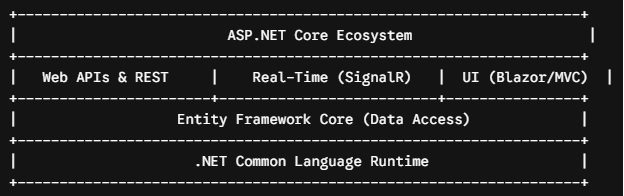
When building a SaaS platform, choosing a framework that handles both backend processing and frontend interaction cleanly can drastically accelerate delivery timelines. ASP.NET Core provides a highly cohesive ecosystem.
High-Performance Web APIs
ASP.NET Core makes it highly intuitive to build clean, RESTful APIs or GraphQL endpoints. It features built-in support for content negotiation, automated OpenAPI/Swagger generation, and strict model validation rules, ensuring your mobile apps or single-page applications (SPAs) communicate with a robust, reliable backend backend.
Real-Time Capabilities with SignalR
Many modern SaaS platforms require real-time features, such as live dashboards, instant notifications, collaborative editing, or in-app chat systems. ASP.NET Core includes SignalR, an incredibly powerful library that abstracts away the complexities of real-time web communication. SignalR automatically manages persistent connections, gracefully falling back from WebSockets to Server-Sent Events or long polling depending on the client’s browser capabilities.
Modern Frontend with Blazor
For teams looking to maximize code reuse, Blazor allows developers to build rich, interactive web UIs using C# instead of JavaScript. By sharing data models and validation logic directly between the frontend and the backend, you eliminate the cognitive friction of switching languages, reducing bugs and significantly speeding up development velocity.
6. Framework Comparison for SaaS Deployments
To understand where ASP.NET Core sits in the wider ecosystem, it helps to compare its core operational attributes against other popular web frameworks used for SaaS development:
| Strategic Vector | ASP.NET Core | Node.js (Express / NestJS) | Python (Django) |
| Type Safety | Static (C#) — Exceptional for large codebases | Dynamic / Static (TypeScript required) | Dynamic (Python) — Fast prototyping, high runtime risk |
| Execution Speed | Extremely High (Compiled) | High (Interpreted V8 Engine) | Moderate (Interpreted) |
| Multi-Tenancy Support | Strong (Native middleware + EF Core filters) | Moderate (Relies on community libraries) | Moderate (Relies on external packages) |
| Eco-system Security | High (Maintained primarily by Microsoft) | Vulnerable to high npm dependency churn | High (Mature built-in security modules) |
| Hosting Cost Efficiency | High (Low memory/CPU footprint on Linux) | High (Single-threaded event loop) | Moderate (Higher resource usage per worker) |
Summary: A Strategic Investment in Longevity
Choosing ASP.NET Core for your SaaS platform offers a rare combination of startup agility and enterprise stability. Its high performance directly reduces cloud infrastructure costs, its cross-platform capabilities free your infrastructure from vendor lock-in, and its extensive built-in security features protect your platform from day one.
Furthermore, Microsoft’s predictable, yearly release cycle guarantees that the framework continuously adapts to modern cloud trends, giving your engineering team a dependable, modern, and high-velocity environment to build, scale, and maintain a successful SaaS product for years to come.

Andriy Kravets is writer and experience .NET developer and like .NET for regular development. He likes to build cross-platform libraries/software with .NET.