If you are a .NET developer, software architect, or engineering manager, you’ve likely faced this crossroads. Do you choose the robust, feature-rich EF Core to maximize your team’s development speed? Or do you strip away the abstractions and use Dapper to squeeze every last drop of performance out of your database?
This article dives deep into the “Entity Framework Core vs Dapper” debate, exploring the eternal trade-off between developer productivity and application performance, and helping you make the right architectural choice for your next .NET project.
The Role of an ORM in Modern .NET Applications
Before we pit these two heavyweights against each other, let’s establish the baseline. An Object-Relational Mapper (ORM) bridges the gap between the object-oriented world of C# and the relational world of SQL databases. It translates your C# objects into database rows and vice versa, saving you from writing thousands of lines of boilerplate data-access code.
However, abstraction comes at a cost. The more an ORM does for you automatically, the more processing overhead it introduces. This is exactly where the EF Core vs Dapper divide begins.
Entity Framework Core: The King of Developer Productivity
Entity Framework Core (EF Core) is Microsoft’s official, flagship ORM for the .NET ecosystem. It is a full-featured, heavily abstracted framework designed to handle almost everything related to database interactions so developers can focus purely on business logic.
Why EF Core Champions Productivity
-
LINQ to Entities: This is arguably EF Core’s biggest selling point. Instead of writing raw SQL strings, developers can query the database using strongly-typed C# Language Integrated Query (LINQ). This means full IntelliSense support, compile-time error checking, and a massive reduction in runtime syntax errors.
-
Change Tracking: When you fetch an entity, modify its properties, and call
SaveChanges(), EF Core automatically knows exactly which fields changed and generates the preciseUPDATEstatement required. You don’t have to manually track state. -
Database Migrations: EF Core allows you to design your database schema using C# classes (Code-First approach). As your application evolves, EF Core generates migration scripts to update the database schema automatically, making version control for databases incredibly smooth.
-
Complex Relationships: Handling One-to-Many or Many-to-Many relationships is a breeze. EF Core maps these relationships to C# navigation properties, allowing you to load related data with simple
.Include()statements.
The Trade-Off: Performance Overhead
All of this “magic” comes with an invisible price tag. EF Core has to translate your LINQ queries into SQL, track the state of every loaded object, and materialize complex object graphs.
-
Translation Overhead: Converting complex LINQ expressions into optimized SQL takes CPU cycles.
-
Memory Consumption: The Change Tracker keeps a snapshot of entities in memory to detect changes, which can lead to high memory usage when querying large datasets.
-
The “N+1” Query Problem: If developers aren’t careful, lazy loading or poorly constructed queries can trigger hundreds of small database calls instead of one optimized join, crippling application speed.
Dapper: The Micro-ORM Built for Blazing Speed
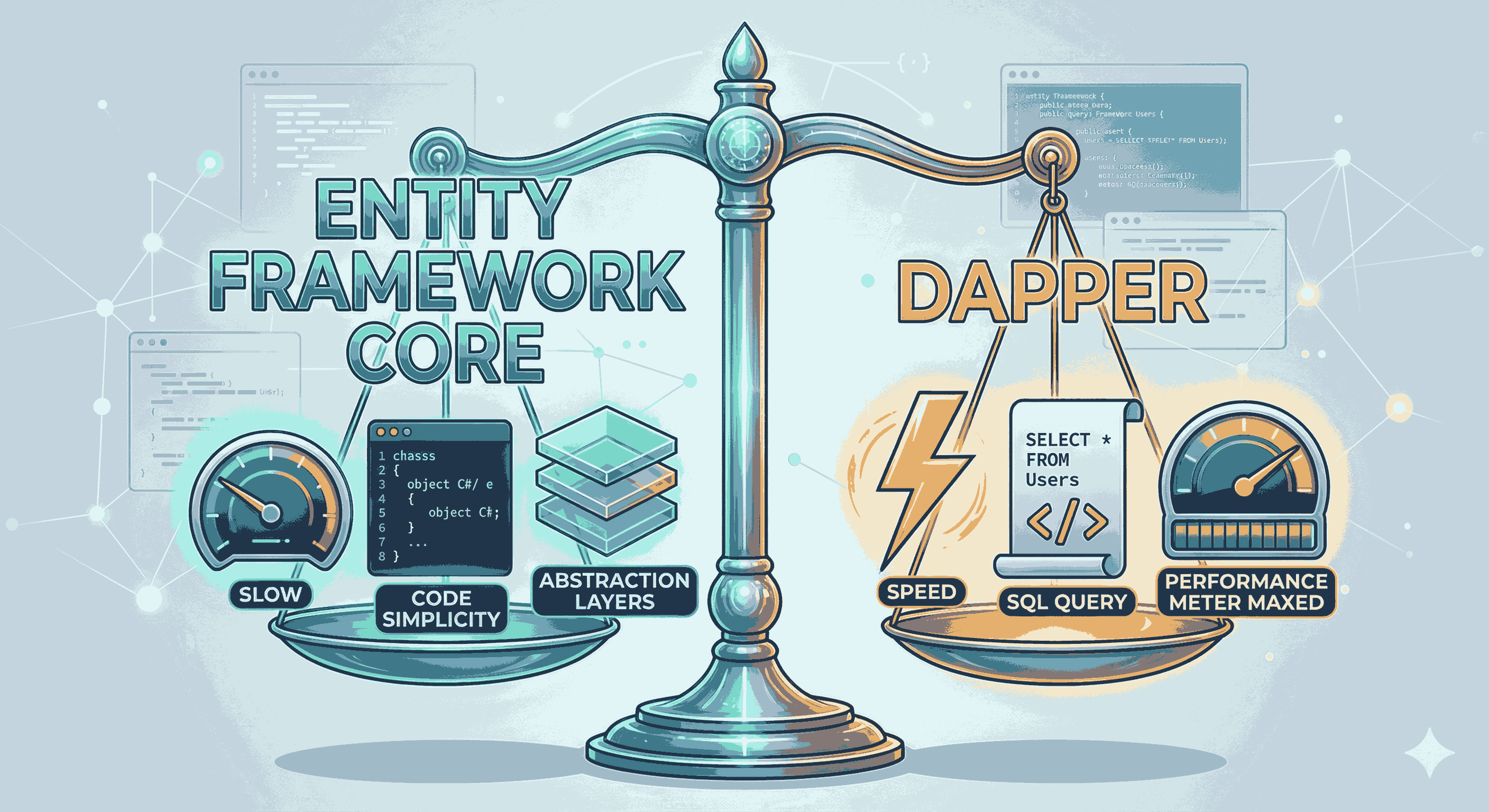
On the other side of the ring sits Dapper. Created by the team at Stack Overflow to handle their massive traffic loads, Dapper is affectionately known as a “Micro-ORM.” It doesn’t try to be everything to everyone; it simply extends the native IDbConnection interface to map raw SQL query results directly to C# objects.
Why Dapper Champions Performance
-
Bare-Metal Speed: Dapper is incredibly fast. Benchmarks consistently show Dapper executing queries and materializing objects at speeds nearly identical to raw ADO.NET. There is virtually zero overhead.
-
Absolute SQL Control: With Dapper, you write your own SQL. This means you can utilize database-specific features, optimize complex joins, write targeted stored procedures, and use common table expressions (CTEs) without worrying about how the ORM will translate them.
-
Lightweight: There is no heavy change tracker, no complex context to instantiate, and no hidden background processes. Dapper simply executes your command and maps the result.
-
Predictability: What you write is exactly what hits the database server. There are no surprise queries generated under the hood.
The Trade-Off: Sacrificing Productivity
While your application will run faster, your developers will have to work harder.
-
No LINQ Translation: You must write SQL as strings. This means no compile-time checking for database queries. A typo in your SQL won’t be caught until runtime.
-
Manual Mapping for Complex Types: While Dapper maps flat tables to objects beautifully, mapping deeply nested, multi-table relationships requires manual effort and complex querying (often using multiple result sets).
-
No Built-in Migrations: You are entirely on your own for database schema management. You’ll need to integrate third-party tools like DbUp or FluentMigrator.
-
Manual CRUD: Want to update a record? You have to write the
UPDATESQL statement yourself. There is noSaveChanges()magic here.
The Core Debate: Productivity vs. Performance
Now that we understand the contenders, let’s analyze the trade-off. In digital marketing and software development alike, ROI (Return on Investment) is everything.
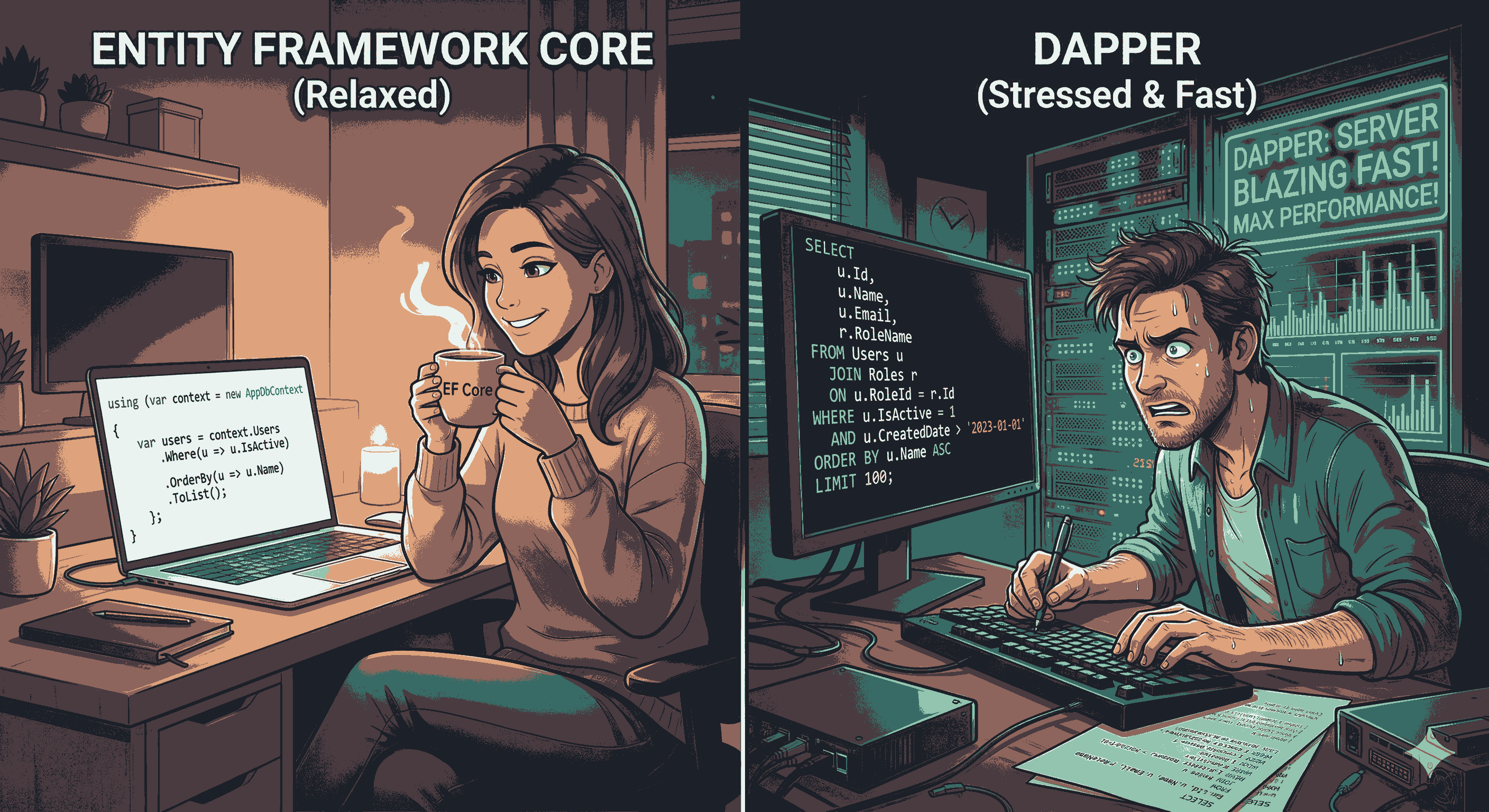
Choosing EF Core is an investment in Developer ROI. You are accepting slightly slower application performance (which can often be mitigated by better hardware or caching) in exchange for faster feature delivery, easier onboarding for new developers, and highly maintainable code.
Choosing Dapper is an investment in Application ROI. You are accepting a steeper learning curve and more verbose code in exchange for a lightning-fast application, lower server resource consumption, and the ability to handle massive concurrent traffic without breaking a sweat.
Let’s Look at a Practical Example
Imagine you need to update a user’s email address.
In EF Core:
var user = await _context.Users.FindAsync(userId);
user.Email = newEmail;
await _context.SaveChangesAsync();
In Dapper:
var sql = "UPDATE Users SET Email = @Email WHERE Id = @Id";
await _connection.ExecuteAsync(sql, new { Email = newEmail, Id = userId });
Multiply these interactions by thousands of endpoints across a massive enterprise application, and you begin to see how drastically these choices impact both the engineering team’s workload and the server’s CPU.
When to Choose Which?
What problem is the user actually trying to solve? Let’s break down the best use cases for each ORM.
You Should Choose Entity Framework Core If:
-
You are building a standard Line-of-Business (LOB) application: CRUD (Create, Read, Update, Delete) operations make up 90% of your app.
-
Time-to-market is your highest priority: You need to build and iterate quickly.
-
You are implementing Domain-Driven Design (DDD): EF Core’s rich mapping capabilities allow you to keep your domain models pure and separate from database concerns.
-
Your database schema changes frequently: EF Core Migrations will save your team from deployment nightmares.
-
Traffic is moderate to high, but not extreme: EF Core 8 (and newer) has made massive performance improvements. For most standard web apps, EF Core is more than fast enough.
You Should Choose Dapper If:
-
You are building a high-traffic, latency-sensitive system: (e.g., an ad-bidding network, a real-time gaming backend, or a high-frequency trading API).
-
You are dealing with legacy databases: If your database has a complex, messy schema that doesn’t map cleanly to object-oriented principles, EF Core will struggle. Dapper lets you write targeted SQL to extract exactly what you need.
-
You have complex reporting requirements: Dashboards that require aggregating millions of rows across dozens of tables are best handled by highly optimized, hand-crafted SQL queries.
-
Your team consists of SQL experts: If your developers are already writing optimized SQL and stored procedures in their sleep, Dapper gets out of their way and lets them work.
The Best of Both Worlds: The Hybrid Approach (CQRS)
The premise is simple: Reads and Writes have different requirements.
-
The Command Side (Writes/Updates): Use Entity Framework Core. When creating or updating data, business rules and data integrity are paramount. EF Core’s change tracking, validation, and complex relationship management make it perfect for the “Command” side of your application.
-
The Query Side (Reads): Use Dapper. When a user requests data, they usually want it instantly, and the data often spans multiple tables (like viewing a dashboard). Use Dapper to execute highly optimized SQL
SELECTstatements and project the results directly into flat Data Transfer Objects (DTOs) for the UI.
By adopting a hybrid approach, you maximize developer productivity for complex business logic while guaranteeing lightning-fast performance for your application’s read-heavy operations.
Conclusion
The Entity Framework Core vs Dapper debate isn’t about which tool is universally “better.” It is about understanding the specific constraints of your project.
If developer hours are your biggest bottleneck and you need to build robust, maintainable systems quickly, Entity Framework Core is the undisputed champion. If server resources are tight, traffic is immense, and you need raw, unadulterated execution speed, Dapper is your go-to micro-ORM.
And if you want the ultimate architecture, don’t be afraid to mix them. Use EF Core to manage your domain and Dapper to serve your data. In the world of software development, understanding the trade-off is the key to winning the game.


Andriy Kravets is writer and experience .NET developer and like .NET for regular development. He likes to build cross-platform libraries/software with .NET.